Case Study: Designing a Real-Time Chat System
A question-driven walkthrough of designing a real-time chat system, focusing on delivery guarantees, ordering, and trust at scale.
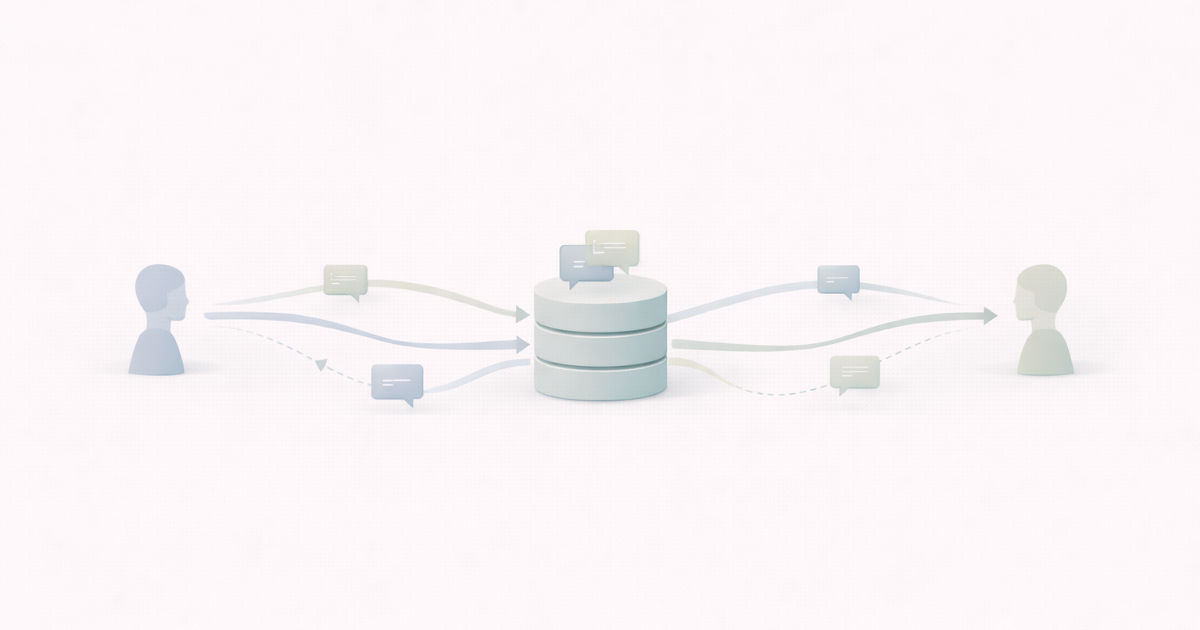
Designing a Real-Time Chat System
What Does “Send Message” Actually Mean?
Someone types a message.
They hit send.
At first, “send” feels binary.
But the moment you slow down, it splits.
Is the message:
- accepted by the server
- delivered to the other user
- stored safely
- shown on the receiver’s screen
Those are different moments in time.
So we decide something early.
“Sent” means accepted and safely stored by the system.
Delivery can happen later.
Visibility can lag.
Who Needs to Be Online?
Does delivery require the receiver to be online?
If yes, messages disappear when users disconnect.
That’s fragile.
So we choose the safer option.
Messages must be delivered even if the receiver is offline.
That immediately implies storage.
Where Does Message State Live?
Message state becomes unavoidable.
We need:
- a place to store messages
- a way to retrieve them later
- a way to track progress per user
flowchart LR
    Sender --> Server
    Server --> Store[Message Store]
    Receiver --> Server
    Server --> Store
The server mediates.
Is Ordering Important?
Messages arrive over the network.
Retries happen.
Multiple devices send concurrently.
Order matters.
Within a conversation, users expect messages to appear in sequence.
So we decide:
The server assigns order.
What Happens When Things Go Wrong?
Failures are normal.
We choose one invariant.
Messages should not be lost.
Duplicates are acceptable.
Loss is not.
What Does “Real-Time” Actually Mean?
Real-time is about perception, not physics.
Users don’t need instant delivery.
They need continuity.
Consistency beats raw speed.
Push is the fast path.
Storage-backed pull is the guarantee.
How Does Delivery Actually Happen?
flowchart LR
    Store --> Push[Push to Online Client]
    Store --> Pull[Pull on Reconnect]
Is This a Fan-Out Problem?
One-to-one chat is simple.
Group chat is not.
Fan-out returns.
What Breaks First at Scale?
Large groups expose pressure.
- connection count
- fan-out cost
- ordering coordination
- storage growth
- silent lag
Each needs containment.
Putting It All Together
flowchart LR
    ClientA --> Conn[Connection Server]
    Conn --> Chat[Chat Service]
    Chat --> Store[Message Store]

    Store --> Push
    Push --> ClientB[Online Client]

    Store --> Pull
    Pull --> ClientC[Offline Client]

    Chat --> Queue[Delivery Queue]
    Queue --> Push
Chat systems are not about speed.
They are about trust that messages will arrive.
What We Already Know
If parts of this felt familiar, that’s intentional. This case study stands on ideas we’ve already built earlier in the series.
Synchronous vs Asynchronous Systems
Chat feels real-time, but reliable delivery depends on async thinking. Push is fast. Storage-backed pull is the safety net.
https://vivekmolkar.com/posts/synchronous-vs-asynchronous-systems/Notifications and Quiet Failure
Message delivery has the same failure modes as notifications. Messages can lag or disappear quietly if we don’t design for retries and visibility.
https://vivekmolkar.com/posts/case-study-notification-system/Retries, Backpressure, and Containment
Fan-out delivery and reconnect storms behave like retry floods. Backpressure is what keeps small issues from cascading.
https://vivekmolkar.com/posts/timeouts-retries-backpressure/Rate Limiting and Fairness Under Load
Group chats turn message delivery into a fairness problem. Without limits and isolation, loud conversations starve others.
https://vivekmolkar.com/posts/case-study-distributed-rate-limiter/
These ideas don’t disappear in chat systems.
They resurface under tighter expectations and more visible failure.