Client–Server Model (Who Does What, Really?)
A calm, first-principles explanation of the client–server model, focusing on responsibility boundaries in distributed systems.
Why This Question Matters Now
Up to this point, we’ve talked about:
- scaling systems
- removing single points of failure
- avoiding server-side memory
- surviving growth
All of that quietly assumes one thing: that different parts of the system have different responsibilities.
System design starts breaking down when this boundary becomes unclear.
A Familiar Situation
You open a food delivery app.
You:
- choose items
- add an address
- tap “Place Order”
Then you wait.
If something goes wrong, you don’t think:
“Maybe I tapped the button wrong.”
You think:
“The system messed up.”
That expectation already assumes a client–server relationship.
The Core Idea (Without Jargon)
The model is simple:
- Clients ask
- Servers decide
Clients:
- send requests
- show results
- retry when things fail
Servers:
- validate requests
- apply business rules
- store the source of truth
Confuse this separation, and systems become fragile.
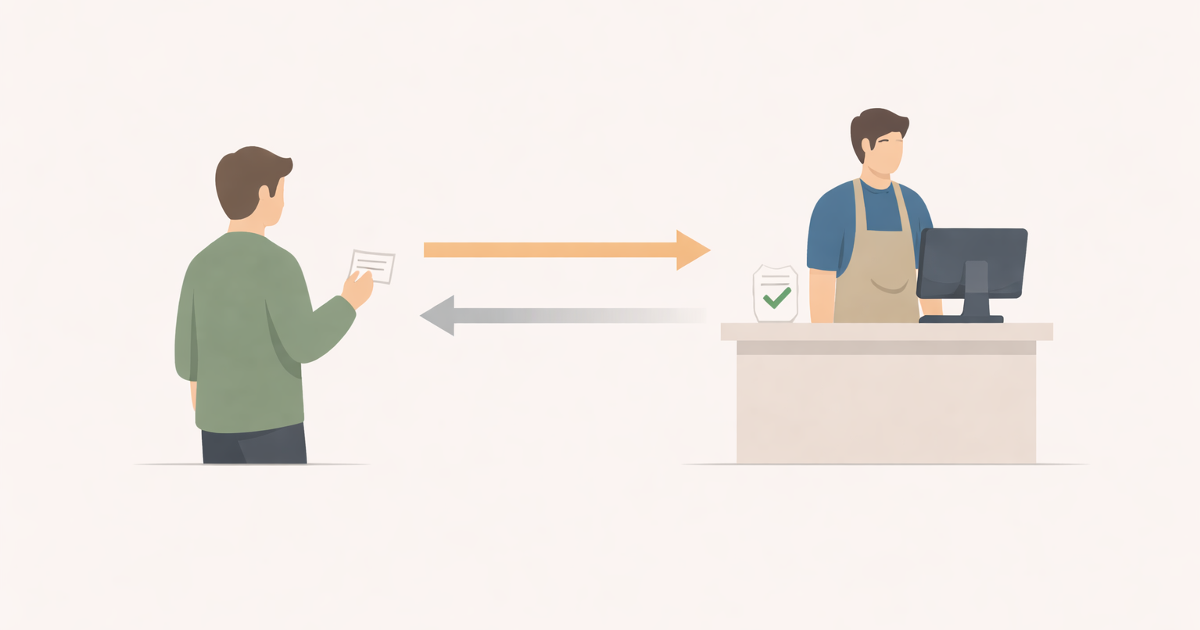
A Simple Story: Ordering at a Café
Imagine a café.
The Customer (Client)
- chooses the drink
- communicates the order
- waits for the outcome
The Barista (Server)
- knows how to make the drink
- checks ingredient availability
- ensures correctness
If customers start deciding:
- prices
- recipes
- availability
Chaos follows.
Software systems behave the same way.
What Clients Are Good At
Clients are good at:
- collecting input
- rendering interfaces
- handling retries
- being replaceable
Clients are not trusted.
They can:
- be slow
- be buggy
- be malicious
- disappear without notice
Systems are designed with this assumption.
What Servers Must Own
Servers are responsible for:
- validation
- business rules
- consistency
- data integrity
If something must be correct, it must be enforced on the server.
Anything else is only a convenience.
Seeing the Boundary Clearly
flowchart LR
    Client -->|Request| Server
    Server -->|Decision + Data| Client
The client initiates.
The server decides.
This clean boundary enables:
- stateless servers
- horizontal scaling
- safe retries
Where Systems Get This Wrong
Problems appear when:
- clients hold critical logic
- servers trust client calculations
- responsibilities leak across the boundary
These systems often work at small scale, and then fail in surprising ways.
How This Connects to Earlier Concepts
Stateless vs Stateful Systems
Servers should not depend on remembering clients.Single Point of Failure
Clients are replaceable; servers must be resilient.Horizontal Scaling
Clear responsibilities allow any server to handle any request.
This model quietly supports everything we’ve discussed so far.
Clients ask.
Servers decide.
Responsibility boundaries make systems scalable.
🤔 Think About This
If a client lies, retries, or disappears, does your system still behave correctly?
If not, the boundary is wrong.
What’s Coming Next
Now that roles are clear, the next question is natural:
Load Balancing
How does the system decide which server handles a request?