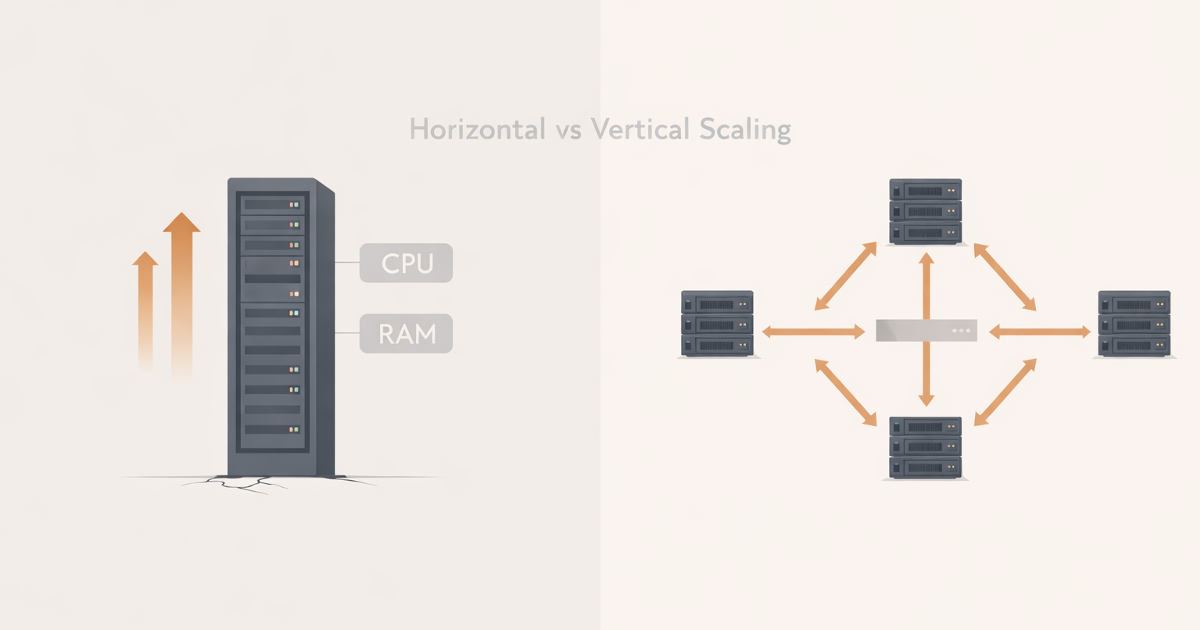
Horizontal vs Vertical Scaling (Growing Out vs Growing Up)
A first-principles explanation of horizontal and vertical scaling using simple, intuitive analogies.
Why This Question Matters
Your system is struggling.
Requests are slow.
Errors are increasing.
Users are growing.
The first instinct is simple:
“Let’s add more power.”
But how you add that power changes everything.
The Core Decision
When a system needs to handle more load, there are only two fundamental choices:
- Make one machine bigger
- Add more machines
These two paths are called vertical scaling and horizontal scaling.
A Simple Story: The Kitchen
Imagine a small restaurant kitchen.
Orders increase.
You have two options:
- Buy a bigger, more powerful stove
- Add more stoves and cooks
Both increase output — but in very different ways.
Vertical Scaling (Scaling Up)
Vertical scaling means:
Making a single machine more powerful.
Examples:
- More CPU
- More RAM
- Faster disk
flowchart LR
    Users --> BigServer[Very Powerful Server]
What This Feels Like
- Simple
- Quick to implement
- No architecture changes
The Hidden Limit
There is always a maximum size a machine can reach.
When it fails, everything fails.
Horizontal Scaling (Scaling Out)
Horizontal scaling means:
Adding more machines to share the load.
flowchart LR
    Users --> LB[Load Balancer]
    LB --> S1[Server 1]
    LB --> S2[Server 2]
    LB --> S3[Server 3]
What This Feels Like
- Slightly more complex
- Requires coordination
- Needs load balancing
The Big Advantage
You can keep adding machines as demand grows.
Failures are contained, not catastrophic.
Where Systems Usually Start — and End
Most systems begin with:
- vertical scaling (easy wins)
Mature systems move toward:
- horizontal scaling (long-term survival)
This transition is one of the most important moments in system design.
A Real Example You’ve Seen
Early-stage apps often run on:
- one big server
Large platforms run on:
- thousands of small servers working together
The second approach is how systems grow without collapsing.
Vertical scaling = grow up (bigger machine)
Horizontal scaling = grow out (more machines)
Growth without sharing always hits a ceiling.
🤔 Think About This
If one powerful server can handle today’s load,
what happens the day it crashes?
What’s Coming Next
Next, we’ll look at a quiet but dangerous problem:
Single Point of Failure
How one small component can bring everything down.