Latency vs Throughput (Why Fast Systems Still Feel Slow)
A first-principles explanation of latency and throughput using simple analogies and diagrams.
Why This Confusion Matters
You open an app.
The backend team says:
“Our system is very fast.”
Yet the screen keeps loading. Spinners spin. Users complain. So what’s going on?
This confusion usually comes from mixing up latency and throughput.
The Real Problem Behind “Speed”
When we say a system is fast, we often mean different things.
Sometimes we mean:
- How long does one request take?
Other times we mean:
- How many requests can we handle at once?
These are not the same thing.
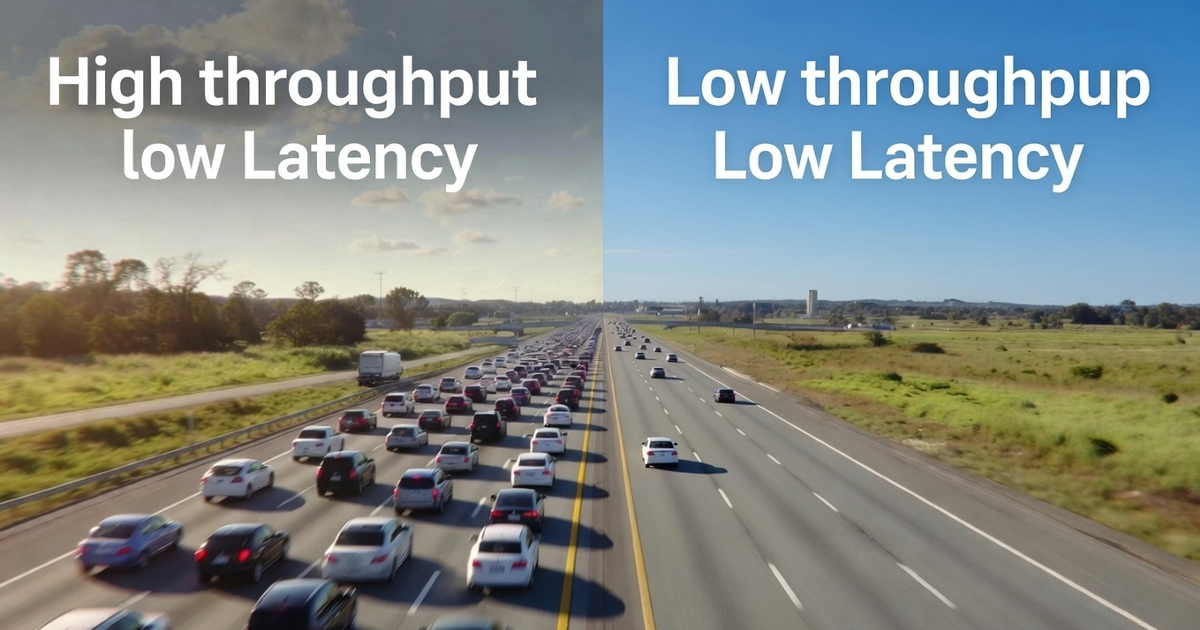
A Simple Story: The Highway
Imagine a highway.
- Latency is how long one car takes to reach its destination.
- Throughput is how many cars pass per minute.
You can have:
- a wide highway (high throughput)
- but still slow traffic (high latency)
Same with software.
The Two Concepts (Names Matter)
Latency
Latency is the time taken for one request to complete.
“I clicked a button — how long did I wait?”
Throughput
Throughput is how much work a system can handle over time.
“How many requests per second can we process?”
Seeing This Visually
High Throughput, High Latency
flowchart LR
    Users -->|Many requests| Server
    Server -->|Slow response| Users
The system handles many users,
but each user waits longer.
Low Throughput, Low Latency
flowchart LR
    User -->|Few requests| Server
    Server -->|Fast response| User
Fast for one user,
but collapses under load.
Where Systems Break
Most real-world systems fail because:
- latency increases under load
- queues build up
- users feel slowness even if throughput is high
This is why:
- “It works on my machine”
- doesn’t mean
- “It works in production”
A Real Example You’ve Experienced
Think of IRCTC ticket booking.
- Thousands of requests per second (high throughput)
- But each click feels slow (high latency)
The system is busy — not broken.
Latency = time per request
Throughput = work per second
A system can be good at one and bad at the other.
What’s Coming Next
Tomorrow we answer another common mix-up:
Scalability vs Performance
Why making things faster is not the same as making them scalable.