Load Balancing (How the System Decides Who Handles Your Request)
A first-principles explanation of load balancing, why it matters, and how it connects to statelessness, scaling, and failure handling.
Why This Question Suddenly Matters
You now have:
- multiple servers
- stateless requests
- clear client–server boundaries
Everything looks ready to scale.
Then traffic increases.
And a quiet question appears:
Which server should handle this request?
If the answer is vague,
you already have a scaling problem.
A Situation You’ve Definitely Experienced
You refresh a website.
Sometimes it’s fast.
Sometimes it’s slow.
Sometimes it fails and works on retry.
Nothing obvious changed.
What actually changed is which server handled your request.
Load balancing is the invisible decision behind that experience.
The Core Problem (No Jargon)
If all requests hit one server:
- that server overloads
- others sit idle
- failures cascade
If requests are spread intelligently:
- work is shared
- failures are absorbed
- performance stabilizes
Load balancing is simply:
Deciding where each request goes — on purpose.
A Simple Story: Multiple Checkout Counters
Imagine a supermarket.
There are:
- 5 checkout counters
- 20 customers arriving together
No Load Balancing
Everyone lines up at the first counter.
Result:
- one long queue
- empty counters
- growing frustration
With Load Balancing
Customers are guided to:
- the shortest queue
- the next available counter
Same people.
Same counters.
Completely different outcome.
That guidance is load balancing.
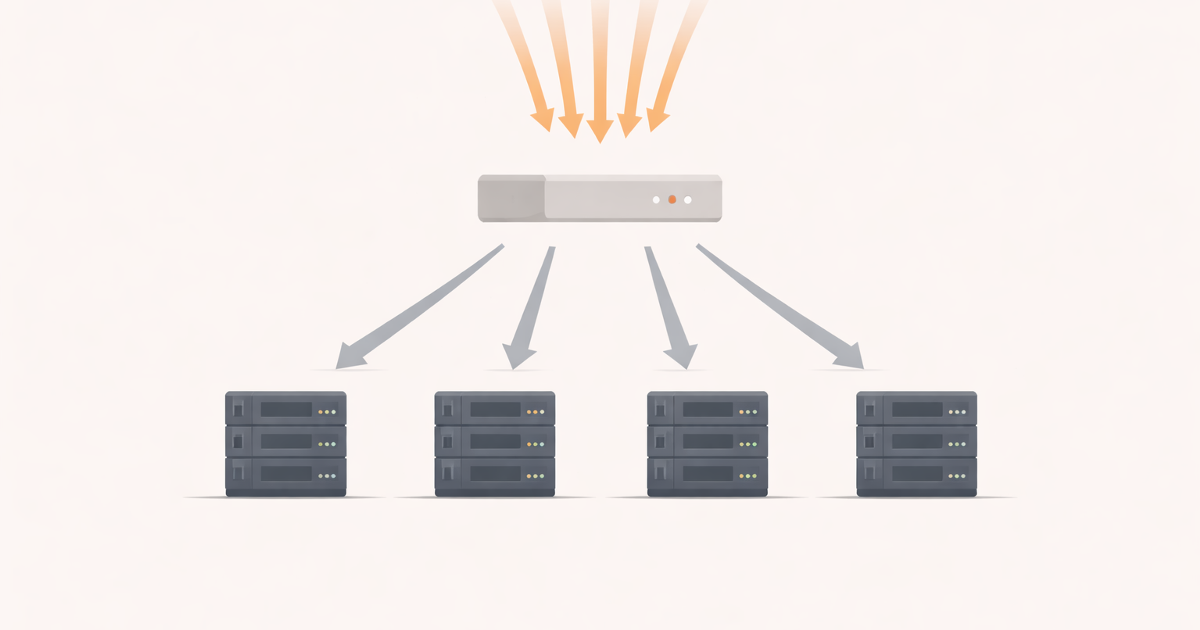
What a Load Balancer Actually Does
A load balancer sits in front of servers.
flowchart LR
    Users --> LB[Load Balancer]
    LB --> S1[Server 1]
    LB --> S2[Server 2]
    LB --> S3[Server 3]
Its job is not business logic.
Its job is to:
- receive requests
- choose a server
- forward the request
- stay invisible
How Does It Choose?
Common strategies include:
- Round Robin — take turns
- Least Connections — pick the least busy
- Random — surprisingly effective at scale
- Sticky Sessions — same client → same server
Each has trade-offs.
⚠️ Common Trap
Trap: Using sticky sessions to “fix” session problems.
This often hides a stateful design flaw
and quietly creates new single points of failure.
Why Load Balancing Enables Everything Else
Without load balancing:
- horizontal scaling doesn’t help
- stateless servers don’t matter
- failures hurt more than they should
With good load balancing:
- traffic spreads naturally
- unhealthy servers are skipped
- systems degrade gracefully
Load balancing is the gatekeeper of scale.
A Real Failure You’ve Seen
In several large outages across major platforms, traffic continued flowing to unhealthy servers.
The result wasn’t total downtime — it was partial, confusing failure:
- some users worked
- others didn’t
- retries made things worse
Poor load balancing amplifies failures instead of containing them.
How This Connects to What We’ve Learned
Client–Server Model
Clients don’t pick servers — the system does.
https://vivekmolkar.com/posts/client-server-model/Stateless vs Stateful Systems
Stateless servers make load balancing safe.
https://vivekmolkar.com/posts/stateless-vs-stateful/Single Point of Failure
A single load balancer can itself become an SPOF if not designed carefully.
https://vivekmolkar.com/posts/single-point-of-failure/Horizontal vs Vertical Scaling
Load balancing is what makes horizontal scaling actually work.
https://vivekmolkar.com/posts/horizontal-vs-vertical-scaling/
Load balancing isn’t about speed.
It’s about fairness, resilience, and predictability.
🧪 Mini Exercise
Take a system you’ve worked on.
- List 3 components that receive traffic
- Ask: How is traffic distributed today?
- Identify one failure case where traffic would make things worse instead of better
You’ll quickly see how mature your load balancing is.
What’s Coming Next
Now that requests are distributed fairly,
another question appears:
Where should logic live before it reaches the servers?
Next up: Reverse Proxy
Why many systems quietly rely on a middle layer you never notice.