Sharding (How Systems Split Data — and Why It’s Harder Than It Looks)
A first-principles explanation of sharding, why systems split data to scale writes, and the trade-offs that make sharding powerful but dangerous.
When Copies Still Aren’t Enough
Replication helped.
Your system survives failures.
Reads scale nicely.
But something still hurts.
Writes queue up.
Indexes grow slower.
Storage keeps expanding.
Even a perfectly healthy database
has physical limits.
At this point, copying data doesn’t help.
You need to divide responsibility.
The Core Idea (Very Plain)
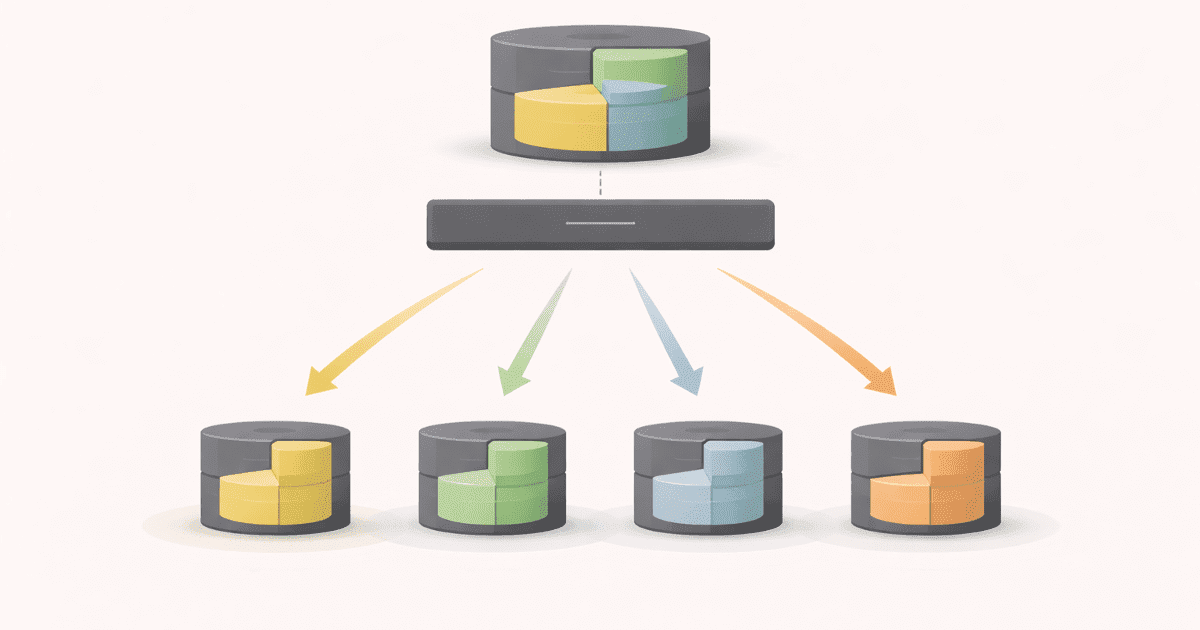
Sharding means splitting data into parts
and storing each part on a different machine.
Instead of:
- one database owning everything
You get:
- many databases, each owning a slice
Each shard is responsible for only its own data.
Together, they form the full dataset.
Sharding vs Replication (No Confusion)
Let’s lock this distinction clearly.
Replication
Copies the same data
→ improves availability and read capacitySharding
Splits different data
→ improves write capacity and storage limits
Replication duplicates responsibility.
Sharding divides responsibility.
They are often used together —
but they solve different problems.
Visualizing Sharding
flowchart LR
    Client --> Router
    Router --> ShardA
    Router --> ShardB
    Router --> ShardC
Every request is routed
to the shard that owns that data.
No shard has the full picture.
Together, they scale.
A Simple Story: Filing Cabinets
Imagine one huge filing cabinet.
As files grow, drawers get heavy.
Finding anything becomes slow.
So you add more cabinets.
Each cabinet holds:
- only certain files
- based on a clear rule
No cabinet has everything.
But together, they store it all.
That’s sharding.
How Systems Decide Where Data Goes
Every sharded system needs a rule:
Given a piece of data,
which shard owns it?
Common approaches (intuition only):
- hashing an ID
- splitting by ranges (A–F, G–M…)
- partitioning by user or tenant
This decision is sticky.
Changing it later usually means:
- moving large amounts of data
- downtime or complex migrations
Why Sharding Is Hard
Sharding introduces new challenges:
- queries that span shards
- transactions across shards
- uneven data distribution (hot shards)
- operational complexity
Replication introduced disagreement.
Sharding introduces fragmentation.
You trade simplicity for capacity.
⚠️ Common Trap
Trap: Sharding too early.
Sharding:
- increases operational overhead
- complicates queries
- makes transactions harder
Many systems scale far with:
- vertical scaling
- caching
- replication
Sharding should be a structural last step,
not an early optimization.
How This Connects to What We’ve Learned
Read-Heavy vs Write-Heavy Systems
Sharding is usually driven by write pressure.
https://vivekmolkar.com/posts/read-heavy-vs-write-heavy-systems/Replication
Often applied inside each shard for safety.
https://vivekmolkar.com/posts/replication/Databases vs Caches
Shards still decide truth — caches don’t.
https://vivekmolkar.com/posts/databases-vs-caches/
Sharding changes where data lives,
not what is correct.
Replication copies data.
Sharding splits data.
🧪 Mini Exercise
Think about a growing system.
- What key could data be split on?
- Would queries often need multiple shards?
- What happens if one shard is slow or down?
If these questions feel uncomfortable,
that’s the real cost of sharding.
What Comes Next
Once data is split across machines…
What happens when a request waits too long — or retries make things worse?
Next: Timeouts, Retries, and Backpressure
Why time becomes the most important failure mode.