Single Point of Failure (How One Small Thing Can Bring Everything Down)
A first-principles explanation of single points of failure using simple, intuitive examples and diagrams.
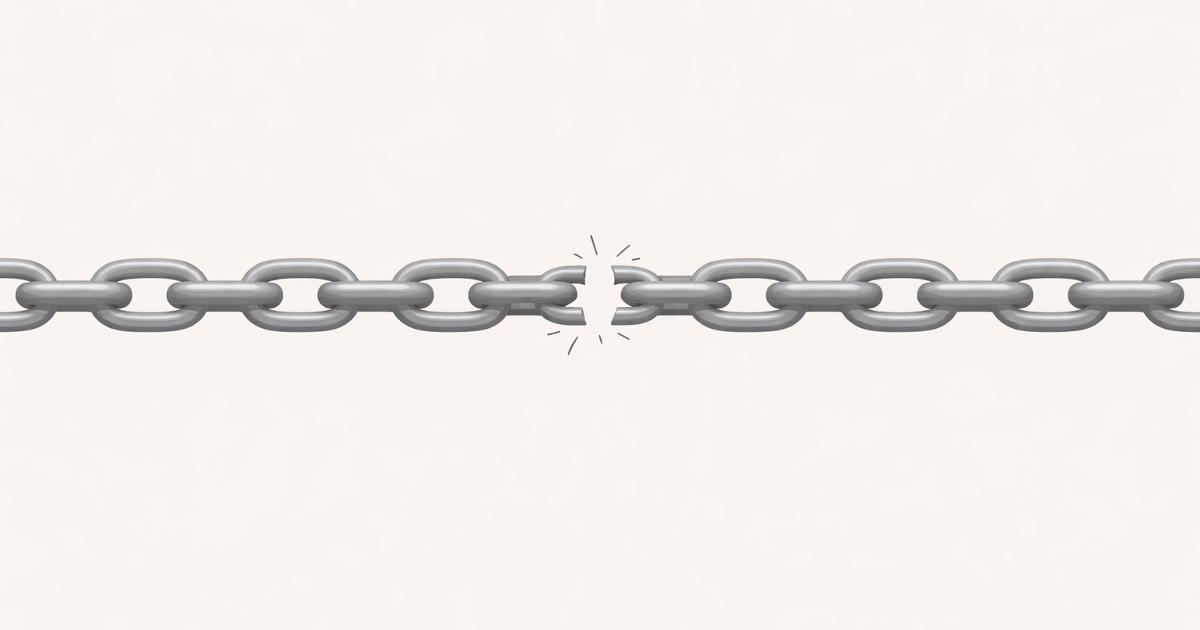
Why This Problem Is Dangerous
Your system works fine.
Users are happy.
Traffic is steady.
Everything feels under control.
Then one small thing fails.
Suddenly:
- the app is down
- users can’t log in
- payments stop working
Not because the system was complex —
but because it depended on one thing too much.
The Quiet Risk Most Systems Start With
Most early systems look like this:
flowchart LR
    Users --> Server
    Server --> Database
Simple.
Clean.
Easy to reason about.
But this design hides a risk: if Server goes down, everything goes down.
That server is a single point of failure.
What Is a Single Point of Failure?
A single point of failure is:
Any component whose failure
causes the entire system to stop working.
It doesn’t have to be big. It just has to be required.
A Simple Story: The Only Key
Imagine an office with:
- one door
- one lock
- one key
Lose the key.
The office still exists.
People are still there.
Work still needs to happen.
But nothing can move.
That key is the single point of failure.
Why Vertical Scaling Makes This Worse
When we scale vertically, we often do this:
flowchart LR
    Users --> BigServer[Very Powerful Server]
    BigServer --> Database
The server is:
- faster
- stronger
- more expensive
But it’s still one machine.
If it crashes:
- performance doesn’t matter
- power doesn’t matter
Everything stops.
How Systems Remove Single Points of Failure
The fix is usually simple in concept:
Don’t rely on just one of anything important.
flowchart LR
    Users --> LB[Load Balancer]
    LB --> S1[Server 1]
    LB --> S2[Server 2]
    S1 --> DB[(Database)]
    S2 --> DB
Now:
- one server can fail
- traffic still flows
- users might not even notice
The system becomes resilient, not perfect.
Where Single Points Still Hide
Even in distributed systems, SPOFs can exist:
- one database instance
- one message queue
- one region
- one credentials store
They’re dangerous because they’re easy to forget.
A system doesn’t fail when everything breaks.
It fails when one required thing breaks.
🤔 Think About This
If one component disappears tonight,
what part of your system would stop completely?
What’s Coming Next
Next, we look at a related but subtle idea:
Stateless vs Stateful Systems
Why remembering things can make systems fragile.